AI in HR Technology 2027: Why Switching to AI Is No Longer Enough
ContinuesAI in HR Technology 2025
Executive Summary
In August 2025 I wrote that every HR team should switch to AI for hiring. That argument is settled. 77% of HR leaders now use AI weekly or daily, up from 54% in 2024.
The question for 2027 is harder. Does the AI you bought produce better hires? So far the evidence is mixed.
- The market is still growing. AI in HR is worth about $8.3 billion in 2026 and is projected to reach $16.83 billion by 2030.
- Results lag adoption. 95% of organizations deployed some form of AI in the past year. One in five got significant value from it.
- Candidates use AI too. Applications per hire have tripled since 2021, and nine in ten US employers believe they have turned away real candidates.
- The rules arrive in 2027. Colorado, California, India, Connecticut and the EU all have compliance dates during the year.
- The market has repriced. Dayforce went private. Workday lost almost half its value by April and is still down 19%. Mercor doubled its valuation to $20 billion.
This is the problem GoodSpace AI is built to solve. Our AI scores every application, screens candidates on WhatsApp and runs a second check before a profile reaches a client. Every shortlist is expert-reviewed before it goes out.
Market Size and Growth Projections
The market kept growing through a hard year for software stocks. Two current estimates:
- The Business Research Company: $6.99 billion in 2025, $8.3 billion in 2026 and $16.83 billion by 2030. That is 19.3% growth a year.
- Precedence Research: $8.16 billion in 2025, $9.49 billion in 2026 and $30.77 billion by 2034. That is 15.94% a year.
On those growth rates, my arithmetic puts the market at about $10 billion to $11 billion in 2027. The two estimates differ by more than a billion dollars because each firm counts different products. The direction is the reliable part: 16% to 19% growth a year.
Regional Insights
- North America is still the largest market.
- Asia-Pacific is growing at 19.75% a year to 2031, and India is the fastest market in the region at 24.27% (Mordor Intelligence).
- India: 47% of employers already use AI in recruitment and another 31% plan to (Indeed survey of 1,267 employers). In campus hiring, 72% of organizations use AI to screen resumes (Deloitte India).
- Europe is the compliance market. The EU's rules for hiring AI now apply from 2 December 2027.
Key Drivers
The 2025 drivers were automation, data and employee experience. The 2027 drivers are more pressing.
- Volume. Applications per hire have tripled since 2021. An open role now draws more than 300.
- Leaner teams. Recruiters handle 93% more applications than in 2021, and recruiting headcount is down 14% (Gem).
- Board pressure. 77% of board members expect AI to deliver productivity and cost savings. Only 3% of organizations exceed their cost-savings goals through productivity (Gartner).
Adoption Trends and Usage Statistics
Adoption depends on what you count.
- People: 77% of HR leaders use AI weekly or daily, up from 70% in 2025 and 54% in 2024 (HireVue, 3,100 respondents worldwide).
- Organizations: 39% have adopted AI in their HR function, and another 7% plan to this year (SHRM, 1,908 US HR professionals).
- Depth: 69% of companies use AI somewhere in hiring. Only 18% use it broadly across the process (iCIMS and Aptitude Research).
The gap between the first two numbers is the story of 2026. People adopted AI faster than their organizations did.
Adoption by Application
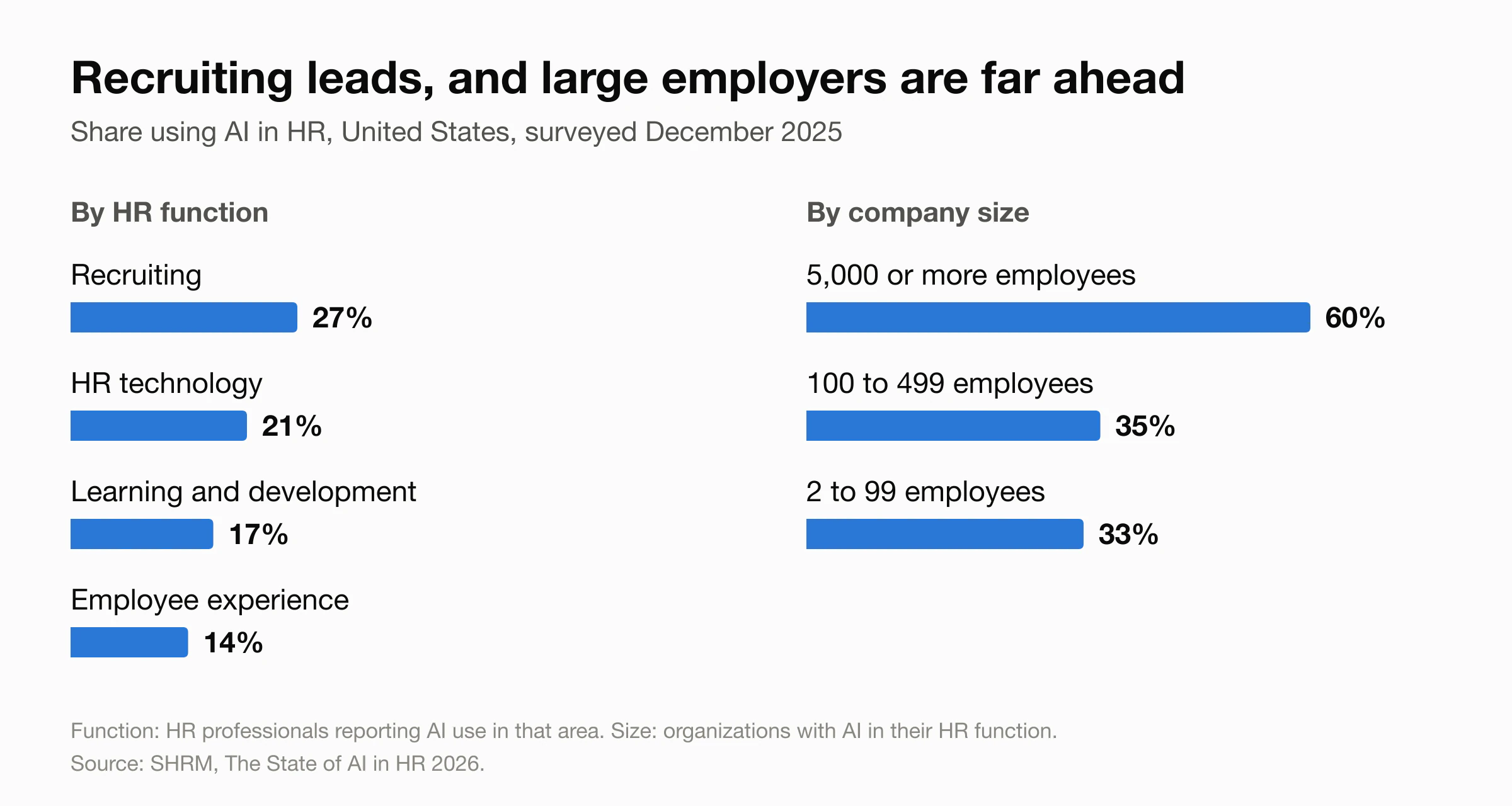
Recruiting still leads, as it did in 2025. SHRM's breakdown of where HR teams use AI:
- Recruiting: 27%
- HR technology: 21%
- Learning and development: 17%
- Employee experience: 14%
Inside hiring, screening is the most common use (58% of organizations), followed by candidate communication (54%), assessments (50%) and sourcing (46%), according to iCIMS.
Adoption by Company Size
Size still decides who has AI. 60% of organizations with 5,000 or more employees use AI in HR. The figure is 35% for those with 100 to 499 employees and 33% for those with fewer than 100 (SHRM).
Agents and AI Interviews
- 46% of companies are using or planning to use agentic AI in talent acquisition (iCIMS).
- 52% of employers already use AI interviews, and 73% use or plan to within a year (Greenhouse, 1,347 recruiters and hiring managers in five countries).
Specific Use Cases of AI
Recruitment and Hiring
- Screening is the most adopted use, at 58% of organizations.
- AI interviews have the strongest evidence. In a field experiment with 70,000 applicants, people interviewed by a voice AI were 12% more likely to get a job offer. They were also more likely to start the job and to stay. Recruiters made every hiring decision.
- Sourcing agents cut search work. LinkedIn says recruiters using its Hiring Assistant review 83% fewer profiles.
- Speed is the weak spot. 28% of employers say time-to-hire is faster than in 2025, and 30% say it is slower (ManpowerGroup, 39,878 employers in 42 countries). A US role takes 62 days to fill.
Learning and HR Service
- Workday paid about $1.1 billion for Sana to add learning agents. 17% of HR teams use AI in learning and development.
- IBM reported that its AskHR agent had automated 94% of routine HR inquiries.
The Candidate Side
The 2025 report looked at AI from the employer's side. Candidates now use AI as well, and they trust it far less.
- Trust. 26% of candidates trust AI to evaluate them fairly. 8% of job seekers say AI makes hiring fairer (Greenhouse).
- AI interviews. 63% of job seekers have faced one. 38% have walked away from a hiring process because of one. Of those who finished one, 51% never heard back (Greenhouse, 2,950 job seekers).
- Gaming. 41% of US job seekers admit hiding text in a resume to get past AI filters (Greenhouse).
- Fraud. Gartner expects one in four candidate profiles to be fake by 2028. In October 2026 the US Justice Department acted against North Korean remote IT worker schemes that affected more than 70 US companies.
- The employer response. 86% of employers have changed their hiring process over fake or AI-generated applications. The most common change is one more human interview.
- Entry-level jobs. Employment for workers aged 22 to 25 in highly AI-exposed jobs is about 19% below where it would be had it kept pace with less exposed jobs. A year earlier the gap was 15%. 22% of CHROs say a business leader has stopped entry-level hiring because of AI (Gartner).
Emerging Technologies
- Agents that do the work. Workday launched autopilot agents in October 2026. LinkedIn's Hiring Assistant went global in September 2025. Oracle, Ashby and Indeed have launched their own.
- Voice AI interviewers. Half of employers already use AI interviews.
- Skills data. SAP is buying TechWolf, which infers employee skills from work data.
- Identity checks. Fraud has made candidate verification part of the hiring stack.
- What faded. Blockchain and the metaverse were on my 2025 list. Neither appears once in the 2026 SHRM or HireVue reports.
Regulation
The 2025 report gave compliance two bullet points. It now needs its own section, because most of the hard dates fall in 2027.
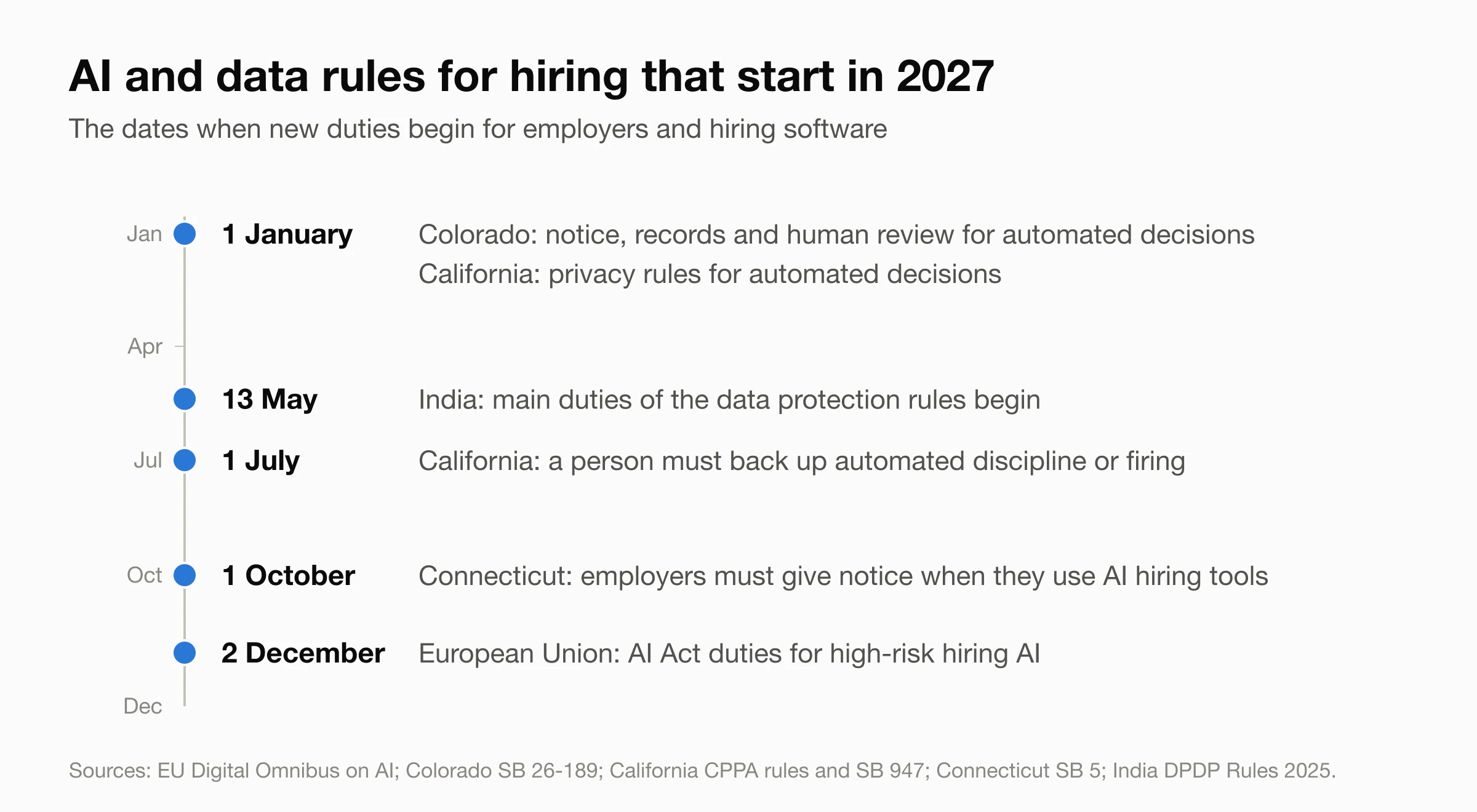
- European Union. Hiring AI is high-risk under the AI Act. Those duties were due on 2 August 2026. The Digital Omnibus moved them to 2 December 2027.
- Colorado. The original AI Act never took effect. Its replacement starts on 1 January 2027 and centers on notice, record keeping and human review.
- California. Privacy rules for automated decisions apply from 1 January 2027. A new law requiring a person to corroborate automated discipline or termination starts on 1 July 2027.
- Connecticut. Since 1 October 2026, using an AI tool is no defense to a discrimination claim. Employer notice duties start on 1 October 2027.
- Ontario. Since 1 January 2026, employers with 25 or more staff must disclose AI use in public job postings.
- India. The Digital Personal Data Protection Rules were notified on 13 November 2025. The main duties apply from 13 May 2027. There is no hiring-specific AI rule yet, but the rules cover the candidate data every employer and hiring platform holds.
- United States, federal. A December 2025 executive order set up a task force to challenge state AI laws. No federal law overrides them yet.
In court, Mobley v. Workday is still the test of whether a vendor can be liable for its screening tool. Not every claim succeeds. In September 2026 a judge dismissed a bias suit over Sirius XM's hiring software, saying "data collection is not the same thing as data discrimination".
Public Markets and Deals
The Dayforce bid I flagged in 2025 went through. Thoma Bravo paid $70 a share, an enterprise value of $12.3 billion, and closed on 4 February 2026. Dayforce no longer trades.
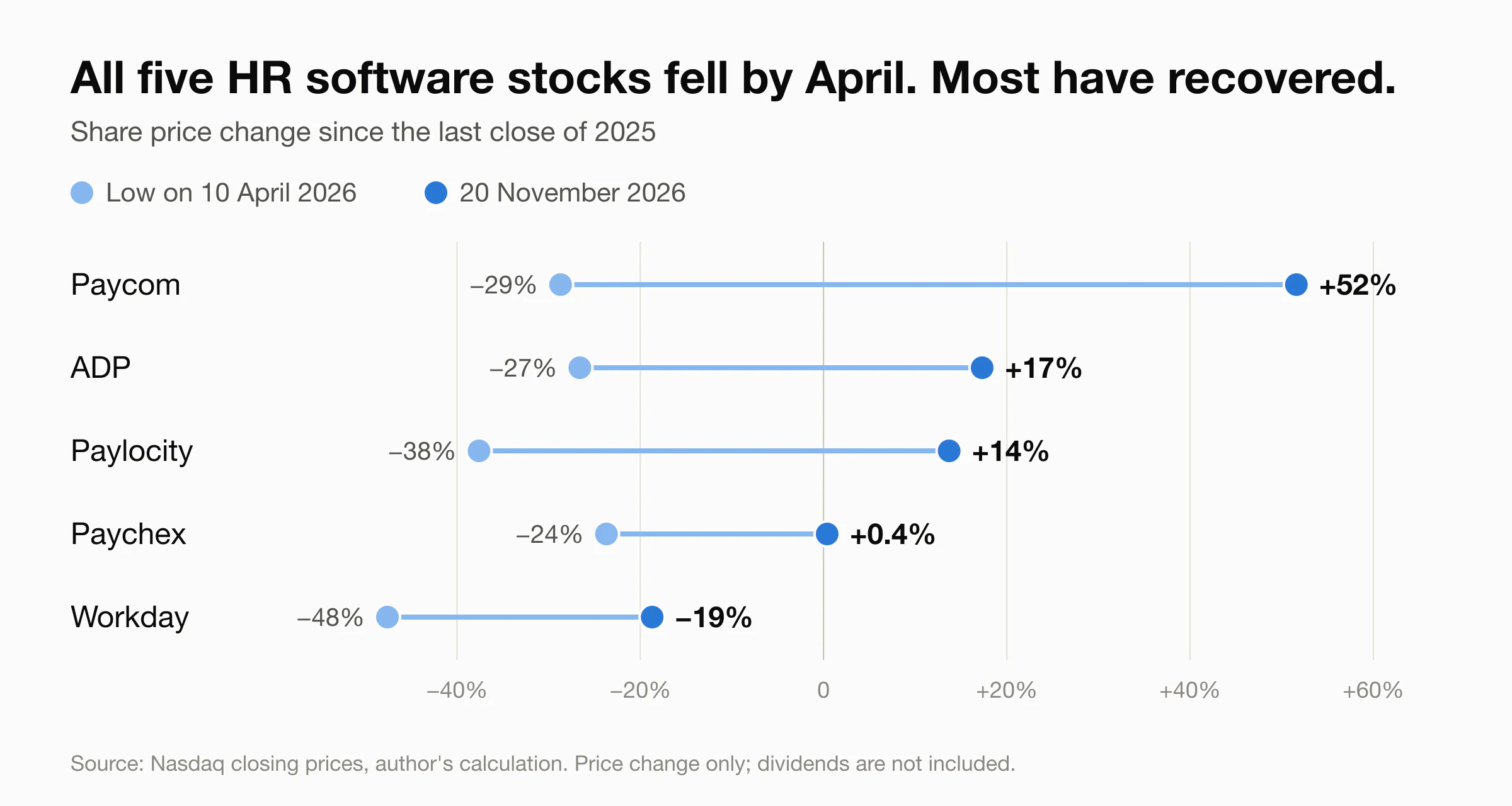
Then the market turned on software. In February 2026 investors sold software stocks on the fear that AI agents would replace packaged software. By 9 April the S&P 500 Software and Services Index was down 25.5% for the year. Workday closed the next day 48% below its 2025 year-end price.
Most of the sector has recovered since. Paycom is up 52% on its 2025 close. Workday is still down 19%.
Workday shows what the year did to the largest pure HR suite:
- Co-founder Aneel Bhusri returned as CEO on 9 February.
- It paid about $2.2 billion for Paradox and Sana to add recruiting and learning agents.
- It cut jobs twice during the year.
- By August, AI drove more than 25% of new contract value, and 5,500 customers used at least one Workday agent.
- On 13 August Reuters reported that Silver Lake was in talks to buy it. No deal has been announced as I write.
Other suites kept buying. SAP closed SmartRecruiters and agreed to buy TechWolf, a skills data company. Korn Ferry agreed to pay about £850 million for AMS. Greenhouse bought Ezra AI Labs for its conversational AI, and HireVue bought the technology behind Hireguide.
Private money went to AI-native companies. Mercor went from a $10 billion valuation in October 2025 to $20 billion in November 2026. micro1 went from $500 million to a reported $4 billion in a year. Juicebox, an AI sourcing tool, raised $80 million at $850 million. Across the sector, WorkTech counted $4.9 billion in 177 deals in the first nine months of 2026.
Efficiency Gains: What the Evidence Says
The 2025 report charted efficiency gains from industry claims. This year I looked for measured results.
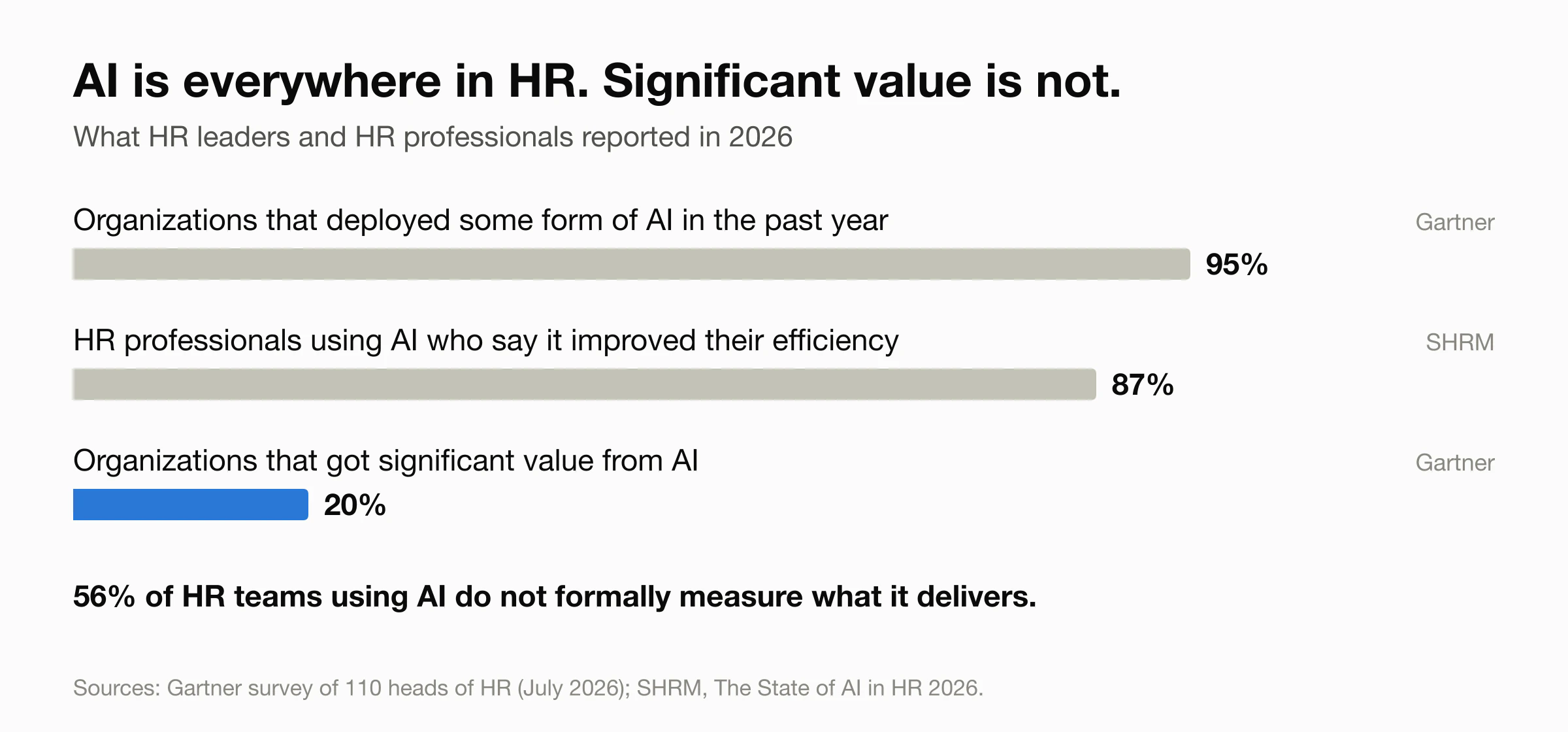
- Use is near universal. Value is not. 95% of organizations deployed some form of AI in the past year. One in five reported significant value (Gartner, 110 heads of HR).
- Most do not measure. 87% of HR professionals who use AI say it improved their efficiency. 56% say their organization does not formally measure the results (SHRM).
- Where it is measured, it can work. The 70,000-applicant interview experiment is the best example: more offers, more job starts and better retention.
- A person in the loop is not enough. In a University of Washington study, people followed a biased AI's picks about 90% of the time. The AI itself has to be tested.
Future Outlook
Seven things I expect in 2027.
- 1. Agents move from pilot to product. Workday's Talent Acquisition Agent is due for general release in early 2027. Gartner expects more than 40% of agentic AI projects to be cancelled by the end of 2027. The agents that survive will own a result, not a task.
- 2. Compliance becomes a buying question. The dates: 1 January (Colorado and California), 13 May (India), 1 July (California human review), 1 October (Connecticut) and 2 December (EU).
- 3. Proof of a real person. With one in four profiles expected to be fake by 2028, expect identity checks and at least one live step before an offer.
- 4. Finance asks for results. More than half of HR teams using AI do not formally measure what it delivers. That will not survive another budget cycle.
- 5. Entry-level hiring keeps changing. The Stanford gap widened from 15% to 19% in a year. Watch whether it widens again.
- 6. More deals. The Workday and Silver Lake talks are unresolved, and the suites are still buying AI companies.
- 7. India grows fastest. Its AI in HR market is forecast to grow about 24% a year, and the data protection rules start in May.
What I Would Do
- Count hires and joins, not screens and messages.
- Tell candidates where AI is used, and give every rejected candidate a way to reach a person.
- Verify identity before the offer, not after joining.
- Ask every vendor for decision records and bias test results.
- Keep a person on the final decision, and test the AI anyway.
Thanks for reading! If you want hiring where AI does the work and every shortlist is expert-reviewed, head over to GoodSpace AI.
The information presented in this publication is for informational purposes only and should not be construed as investment or legal advice, or as a recommendation to buy or sell any security. The views expressed are solely those of the author and do not represent the views of any company, employer, or affiliated party.
All external data comes from the public sources linked in the text, and vendor surveys are named as such. Share price changes are my own calculations from Nasdaq closing prices. While the information is believed to be accurate and from reliable sources, no warranty is made as to its completeness or accuracy, and no liability is accepted for errors or omissions. Past performance is not indicative of future results.